
Domaine de L’Aigle à Deux Têtes
‘Les Clous’ Naturé Muscaté 2023
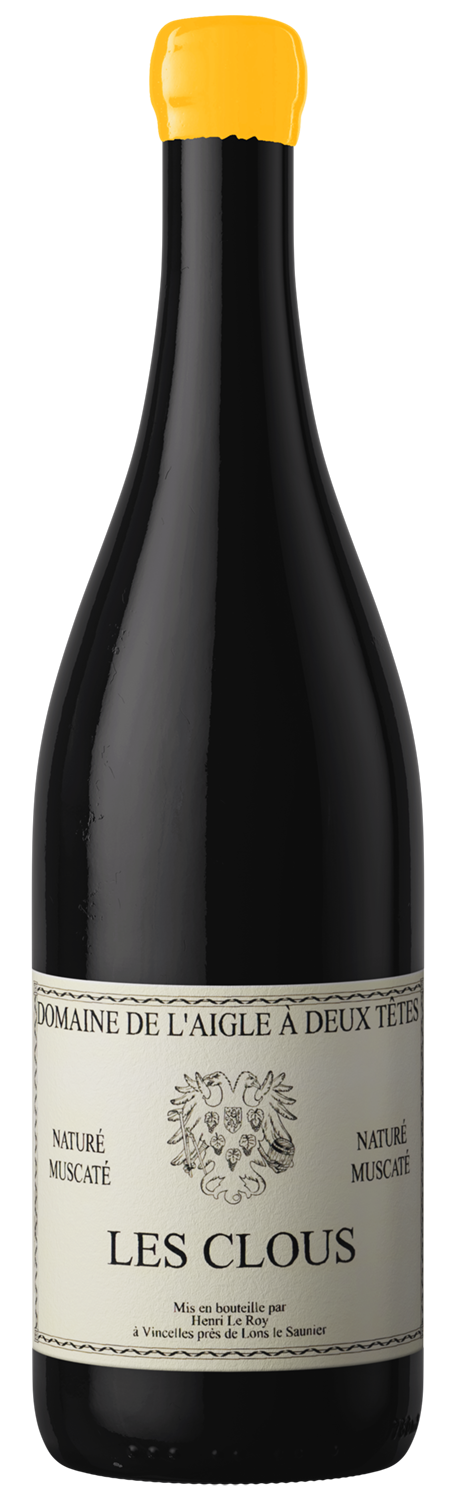
Domaine de L’Aigle à Deux Têtes ‘Les Clous’ Naturé Muscaté 2023
Henri Le Roy is an auto-didactic vigneron farming historic terroir in the dramatic southern Jura in eastern France. A former geneticist and biologist from Paris, Le Roy gave up the sterile and precise scientific life to pursue the soulful craftsmanship and exciting variability of winemaking. Aspiring to work in Burgundy, but priced out of that region, he purchased parcels in the Jura near famous estates located on the slopes of Rotalier and Grusse. His Burgundian winemaking sensibilities came along with him, and were reinforced with support from his neighbor, Jean-François Ganevat, who advised him to employ the non-oxidative (ouillé) method.
Naming his estate for the heraldry of the Habsburg empire that once held sway over the region, Henri pursues back-to-basics, elegant and transparent wines that convey the ancient marl soils and lush green hills of the Jura. He farms his 3.5ha using organic principles (but has eschewed the bureaucracy of certification in recent years), utilizing only natural fertilizer and pest deterrents. In his winery, Le Roy seems relieved to have left behind his past laboratory work, gladly allowing native yeast to vinify his indigenous grape varieties, and topping up his old French barrels to maintain tension and purity of the wines. He shrugs off onerous, artificial strategy and external dictates—his objective is to get out of the way and let the vision of the wines be dictated by the Jurassic air, soil, and iconic grape varieties. Henri invites us to “taste the wines, concentrate, and dream. That’s the relevant argument for [them].”
Located near his small winery, the Les Clous vineyard features two of the grapes most strongly associated with the Jura, and almost nowhere else: savagnin and poulsard. Locally, the savagnin grape can be referred to as naturé—this nomenclature suggests the ouillé style of winemaking, whereas savagnin is known to presume a wine made sous voile.
Shortly after Henri purchased the vineyard, his neighbor, Jean-François Ganevat, directed his attention to an enviable rarity on his new property: a mutation of naturé called muscaté, of which it is believed less than half a hectare is planted globally. Seemingly an evolutionary anomaly between traminer and savagnin, naturé muscaté blanc reveals itself by expressing white flowers and exotic fruits, and salinity on the palate. Tempered with “regular” naturé to balance out the intensity of muscaté, this wine is a compelling and beguiling glimpse of a lesser-known Jura style.
Vinification — Spontaneous, native yeast fermentation is initiated in steel vat (more permeable than stainless steel, which Henri feels creates a “more flexible, less hard” wine) and then moved to used French oak barrels to complete alcoholic and malolactic fermentation. Les Clous Naturé Muscaté is aged for at least 10 months in the fermentation barrels. SO2 is used very minimally, and only after MLF and just before bottling. Vinified ouillé—barrels topped up, non-oxidative.