
Domaine de L’Aigle à Deux Têtes
‘Charmes-Vernambaud’ Pinot Noir 2023
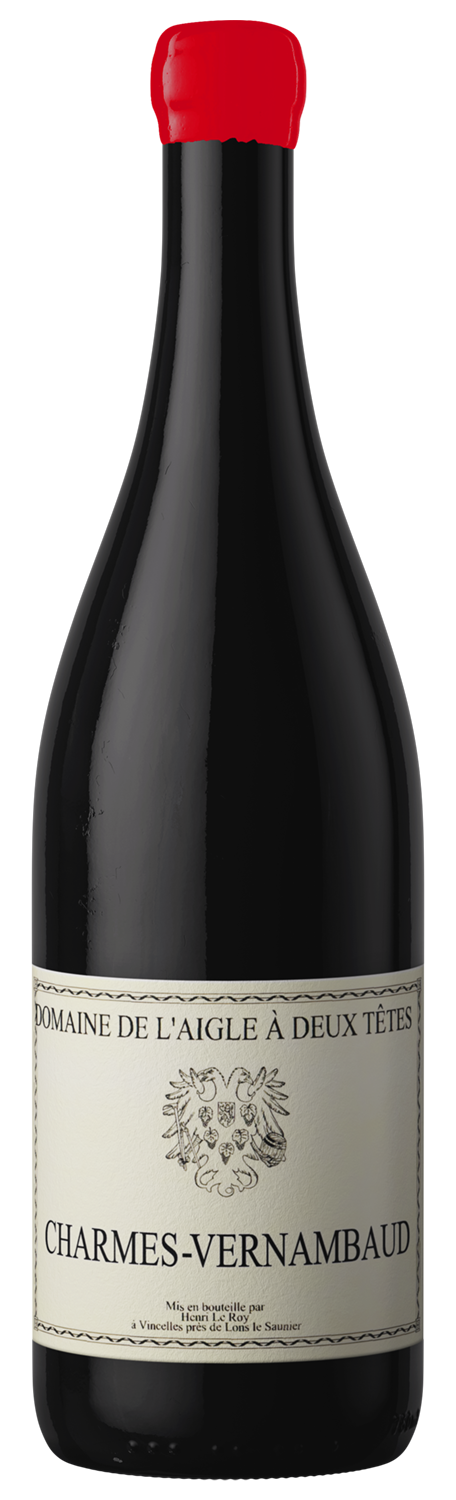
Domaine de L’Aigle à Deux Têtes ‘Charmes-Vernambaud’ Pinot Noir 2023
Henri Le Roy is an auto-didactic vigneron farming historic terroir in the dramatic southern Jura in eastern France. A former geneticist and biologist from Paris, Le Roy gave up the sterile and precise scientific life to pursue the soulful craftsmanship and exciting variability of winemaking. Aspiring to work in Burgundy, but priced out of that region, he purchased parcels in the Jura near famous estates located on the slopes of Rotalier and Grusse. His Burgundian winemaking sensibilities came along with him, and were reinforced with support from his neighbor, Jean-François Ganevat.
Naming his estate for the heraldry of the Habsburg empire that once held sway over the region, Henri pursues back-to-basics, elegant and transparent wines that convey the ancient marl soils and lush green hills of the Jura. He farms his 3.5ha using organic principles (but has eschewed the bureaucracy of certification in recent years), utilizing only natural fertilizer and pest deterrents. In his winery, Le Roy seems relieved to have left behind his past laboratory work, gladly allowing native yeast to vinify his indigenous grape varieties, and topping up his old French barrels to maintain tension and purity of the wines. He shrugs off onerous, artificial strategy and external dictates—his objective is to get out of the way and let the vision of the wines be dictated by the Jurassic air, soil, and iconic grape varieties. Henri invites us to “taste the wines, concentrate, and dream. That’s the relevant argument for [them].”
Henri’s newest parcel, ‘Vernambaud’, is a magical vineyard framed by mountain cliffs and forests near the quiet stream of La Sonnette, just outside the historic village of Grusse. At Vernambaud, southwest-facing Pinot Noir vines are surrounded like an amphitheater by woods. Although they get four hours less sun than a full south-facing parcel, the vines retain balance due to the protection afforded by the trees. The soils here are rich in blue marl and the site is known to provide beautifully balanced fruit of intensity and purity. The neighboring vineyard is tended by Kenjiro Kagami of Domaine des Miroirs. This appropriately-named wine is indeed charming, reflecting the unmistakable Jura minerality along with pure, shimmering eastern French orchard cherries in all their dimensions.
Vinification — Spontaneous, native yeast fermentation is initiated in steel vat (more permeable than stainless steel, which Henri feels creates a “more flexible, less hard” wine) and then moved to used French oak barrels to complete alcoholic and malolactic fermentation. Whole cluster varies depending on the vintage (none in 2023, 50% in 2022), but the grapes are always destemmed, and pigéage is applied only on the first day. Charmes-Vernambaud is aged for at least 10 months in the fermentation barrels. SO2 is used very minimally, and only after MLF and just before bottling.