



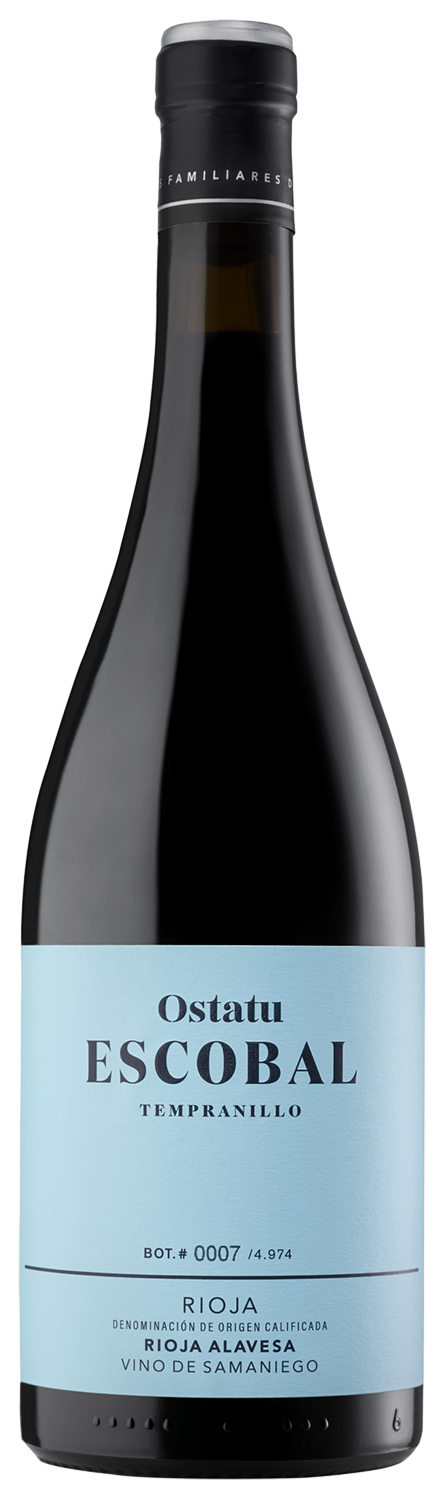
In their role as leaders for sustainability and regenerative farming in their native Rioja Alavesa, the Saenz de Samaniego siblings have obtained their organic farming certification for their entire production in 2022. This task is immensely complicated in Rioja by the fact that they have dozens of tiny plots, and each must be certified individually. The standard for organic viticulture is exceptionally high in Spain, making them a model for other nations. The fact that Ostatu exclusively owns and farms the entirety of their single vineyards allows them total control of the production from start to finish. Such is the dedication and commitment of the Saenz de Samaniego family. If this were Piemonte, the wines would cost many times more than they currently do in Rioja Alavesa, exemplifying the inherent value there.
To start, they have gained organic certification for one of their larger contiguous vineyards, called Escobal, a southwest-facing plot at 550m near their village of Samaniego. With clay-calcareous soils under a layer of sand and gravel, the vineyard lies directly in the foothills of the Sierra Cantabria mountains in a Mediterranean climate with a strong Atlantic influence. Not only has the Escobal vineyard been farmed organically without synthetic inputs since the 2010 vintage, but they have also encouraged the regeneration of the soil and environment through the integration of native fauna. Furthering this commitment to the environment, Ostatu is also a carbon-neutral winery. Ostatu is pure Cantabrian mountain viticulture at its finest, as many have made comparisons with the best wines of Italy’s Alto Piemonte and Valtellina regions. We don’t disagree.
Vinification
After a manual harvest, the grapes are destemmed but not crushed, and fermented whole by native yeasts in stainless steel tanks. The fermentation lasts 14 days at a temperature of 24°C, with occasional gentle pump-overs. The wine is then pressed and racked into a large, previously used French oak foudre for malolactic fermentation and 11 months of aging in 10,000L botti. Only very minimal sulfur is employed throughout the process.
Region
Rioja Alavesa
Appellation
Rioja
Village
Samaniego
Site
Escobal
Elevation
550m
Grapes
100% Tempranillo
Vine Age
Vines planted in 1995
Soil
Clay, limestone, gravel, sand, and stone
Fermentation
Fermented with native yeasts in stainless steel
Aging
Five months in used 500L French foudre and 11 months in 10,000L botti (traditional wooden cask for aging wine)
Farming
Certified Organic by ENEEK (Basque Organic Regulatory Council)
S02 Total
51mg/L
Vegan
Yes
ABV
14.5%
Pack Size
12x750mL